
Translating planetary health diet guidelines into school meals is about more than nutrition. It involves taste, culture, education and the realities of school kitchens. Children do not eat guidelines. They eat food. A meal may be healthy and sustainable on paper, but if children do not enjoy it, it cannot deliver its intended benefits.
To address this challenge, SchoolFood4Change (SF4C) developed the PLANETS pathway (PLANetary hEalth dieT for Schools), coordinated by the University of Gastronomic Sciences of Pollenzo. The initiative aimed to bridge the gap between scientific recommendations and the daily realities of school food systems across Europe.
Starting from evidence: acceptance comes first
Research shows that children’s acceptance of food depends on taste, texture, appearance, familiarity and social context. This is particularly relevant when introducing more plant-based meals. For this reason, SF4C focused not only on healthier menus, but also on making sustainable meals appealing and enjoyable.
Cooks designed the training pathway, creating a programme for the people who make school meals possible: Urban Food Enablers, Food Ambassadors, teachers, dieticians, procurers, families and local authorities. Guided by the School Menu Design Handbook, the programme focused on three key dimensions: understanding food preferences, using progressive exposure and circular cooking, and promoting active learning.
PLANETS addressed three major challenges. First, the acceptability gap: children respond to what they see, smell and taste, not to sustainability indicators. Training therefore explored sensory design, flavour development and ways to introduce new ingredients through familiar formats. Second, the implementation gap: school food systems vary widely across Europe, requiring flexible approaches that can be adapted locally. Third, the evidence gap: more knowledge is needed about which sustainable recipes work best and why. SF4C addressed this by integrating sensory testing directly into the training process.
The pathway was developed through a participatory process involving partners from 18 geographical settings in 12 countries. Combining online learning, practical kitchen sessions, peer exchange and local adaptation, it created a shared framework while supporting local ownership.
The results demonstrate the scale of the initiative. Seventy trainers completed the programme and delivered cascade activities reaching 5,392 participants through 550 hours of training. The process strengthened local capacities and supported the development of healthier and more sustainable school meals.
From training to tools: making the transition operational
Three practical tools helped translate principles into action:
- The Recipe Framework, supporting the creation of healthy, sustainable and feasible school recipes.
- A sensory testing protocol, allowing children’s feedback to inform recipe development.
- The Canteen Days model, connecting meals with education, families and local communities. More than 100 Canteen Days engaged over 20,000 participants.
One of the most tangible outcomes was the development of 42 plant-forward recipes by school catering chefs from 12 European countries. The recipes addressed practical challenges such as protein transition, balanced meals, reducing food waste and adapting dishes to local contexts. Together, they demonstrate how sustainability principles can be translated into everyday school menus.
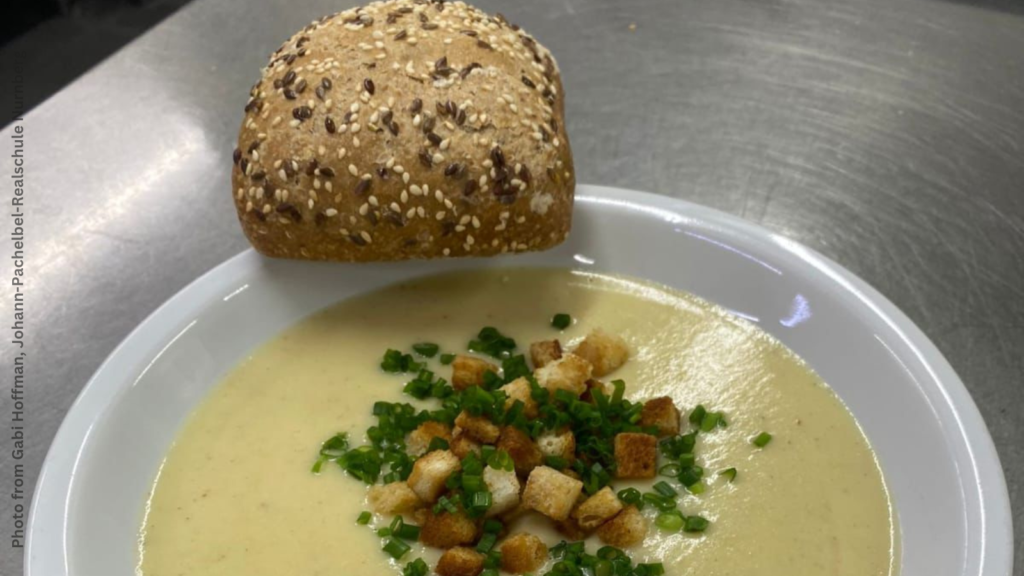
Children’s feedback played a central role. Across 12 countries, 2,324 valid sensory responses were collected from pupils aged 9–15. Results showed that acceptance varies by context, with pasta-based dishes and legume burgers generally performing better than soups. Positive emotional responses were associated with greater acceptance and lower food waste, while food neophobia often reduced acceptance.
A key lesson from the project is the importance of cooks. Far from simply executing menus, cooks act as mediators between nutrition, sustainability, procurement and children’s experiences. Through culinary skills, creativity and everyday practice, they help transform guidelines into meals that children genuinely enjoy.
The project also reinforced the value of the Whole School Food Approach. School meals are not only a service but an educational opportunity. Activities such as Canteen Days, sensory education, school gardens and cooking workshops help make sustainable food familiar, visible and socially accepted.
Carrying forward a message
The core message of this journey is that planetary health meals become acceptable when sensory quality, familiar formats, progressive exposure, active learning, trained professionals and community engagement come together.
In SF4C, the aim was to fill the gap between the guideline and the plate by training the people who make the meal real.
“Col cibo si educa, col cibo si cambia” – through food, we educate; through food, we change.
This journey carries forward a message strongly promoted by Carlo Petrini, UNISG and Slow Food through the appeal “Col cibo si educa, col cibo si cambia”. For UNISG, Slow Food and SchoolFood4Change. This is not only a way to remember him, but a way to continue his message through concrete work in schools, canteens and communities.
The journey reminds us that food is never just food. Food is education, culture, public responsibility and a concrete driver of change. We also remember that human happiness passes through the body, through the senses, and through the freedom to satisfy them. If this satisfaction is shared, even better. And if we can experience it with the serenity of knowing that what we are eating is also good and right – for ourselves, for others and for the planet – then the school meal becomes a daily exercise in change.
That is where education begins. And that is where change becomes possible.