
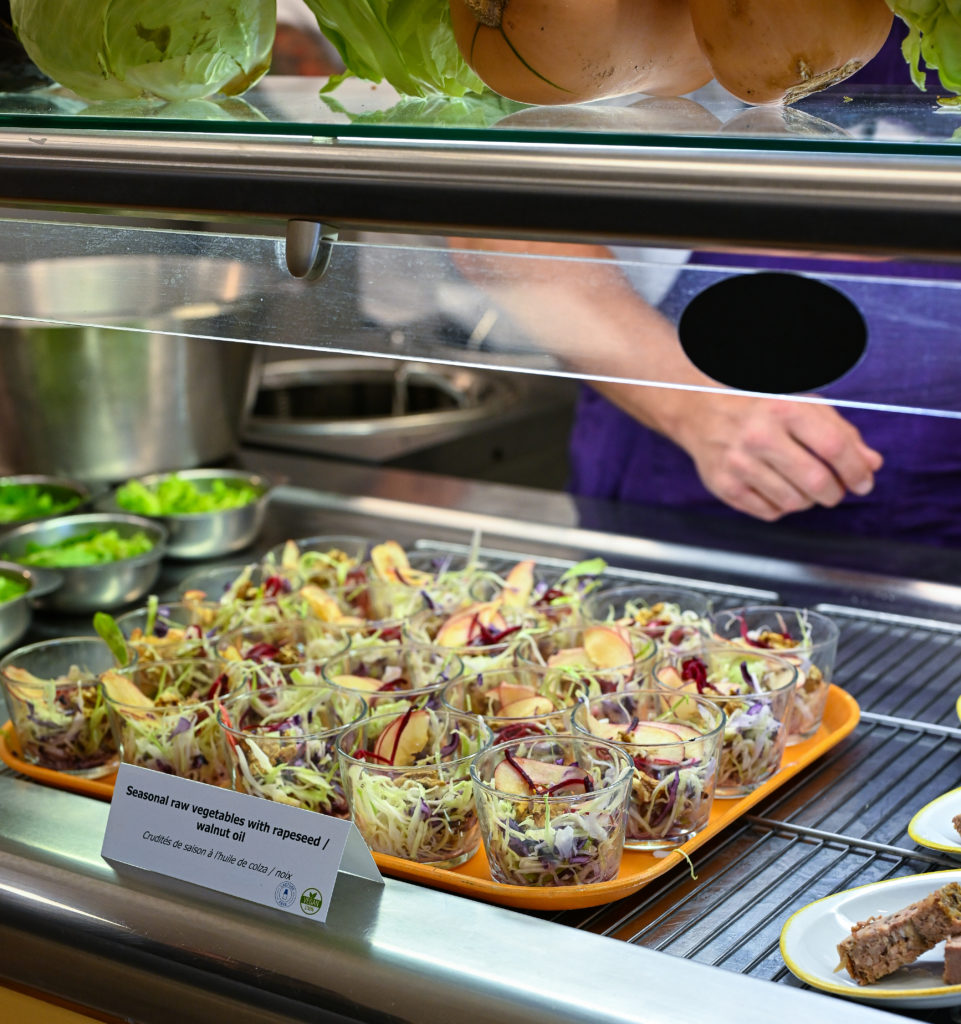
There are many measures schools can take to provide students with healthier, tastier and more sustainable school meals. However, as the SchoolFood4Change School Menu Design Handbook notes, in order for these measures to have meaningful impact, they can’t just be a loose collection of actions. They must be integrated into a broader vision that connects health to environmental benefits, understanding that humans, the environment and animal welfare are intrinsically linked, following the One Health Principle. This means that a healthy school meal is about much more than nutrition alone. It should support students’ wellbeing while also considering the health of our planet, especially in the face of climate change, biodiversity loss, animal welfare concerns, and the growing scarcity of natural resources. Taking a more systemic view helps us see how everyday choices in school meals can contribute to a more sustainable future.
The need for a holistic approach in rethinking school meals
In practice, a systemic approach to developing school meals demands consideration of all sectors associated with it, and their interactions. Health benefits, commercial interests, energy infrastructures and environmental concerns are all affected by the choice of school meal, requiring knowledge of the diverse stakeholders involved and the “multi-sectoral impact of school meals on society”, as well as an understanding that the impact of food on pupils is not only measured through consumption. Eating ‘healthier’ food will not contribute to people’s wellbeing if the ways in which it is produced, processed and managed have negative planetary consequences.
Such a holistic vision of food systems makes it easier to create interventions that have a systemic scope that can contribute to structural change. As the handbook notes:
“it is necessary to ensure the involvement of the various stakeholders and to intervene according to a multi-level and multi-scale logic. This means constructing change by taking advantage of the relationships between stakeholders, understanding how improvements and changes in a given area of action can bring benefits to the whole system, and choosing strategic areas to use as levers. After an initial focus, these can have cascading effects once developed.”
The circular economy approach
The circular economy has a major role to play in rethinking school meals. Circular economy seeks to foster business models and behaviour which decouple resource use from economic activity by maintaining the value and utility of products, components, materials and nutrients for as long as possible, in order to close material loops and minimise harmful resource use and waste generation. The European Commission has increasingly been promoting circular approaches both in general, through the Circular Economy Action Plan, and more specifically in the agricultural sector, through its Farm to Fork Strategy.
The school lunch system offers many possibilities for the implementation of circular principles, notes the handbook. Using agricultural models and supply chains that seek to regenerate (local) resources has a major impact. Moreover school canteens can pay more attention to how ingredients are selected, managed and packaged, structure menus in a way that reduces food waste, and add value to by-products. The handbook highlights the many different ways in which “cyclicality” can become the main operation framework when working in the kitchen. It does this using the “10 R’s framework” centred around refuse (R0), rethink (R1), reduce (R2), reuse (R3, repair (R4), refurbish (R5), remanufacture (R6), repurpose (R7), recycle (R8), recover (R9).
The 10 R’s are listed hierarchically based on their impact on the circular economy. As the handbook notes, following these principles of priority in the context of school food means that it’s of key importance to move to a more efficient production and use of raw materials (refuse, rethink, reduce), followed by extending the useful life of a product and its components (reuse, repair, refurbish, remanufacture, repurpose), and finally to value to unavoidable waste/waste by incorporating it, where possible, into new production cycles (recycle, recover).
The SchoolFood4Change School Menu Design Handbook can be downloaded here.